
How Texans Used Marijuana in 2026: Survey Findings
- Texas Cannabis
- Cannabis News
- How Texans Used Marijuana in 2025: Survey Findings
Texas cannabis survey 2025 shows most respondents use cannabis for relief, not just recreation
A recently finalized survey conducted by TexasCannabis.org over the course of 2025 suggests that many Texas respondents viewed cannabis and intoxicating hemp less as a recreational product and more as a tool for relief. Most said they used it for anxiety, stress, pain, sleep, or depression. Many also reported regular use, strong support for legalization, and frustration with current marijuana laws.
Take the current survey
Take part in the survey to help identify what matters most to cannabis consumers and businesses this year.
Most Texas respondents reported medical or mixed cannabis use
Texas respondents leaned heavily toward medical or partly medical use.
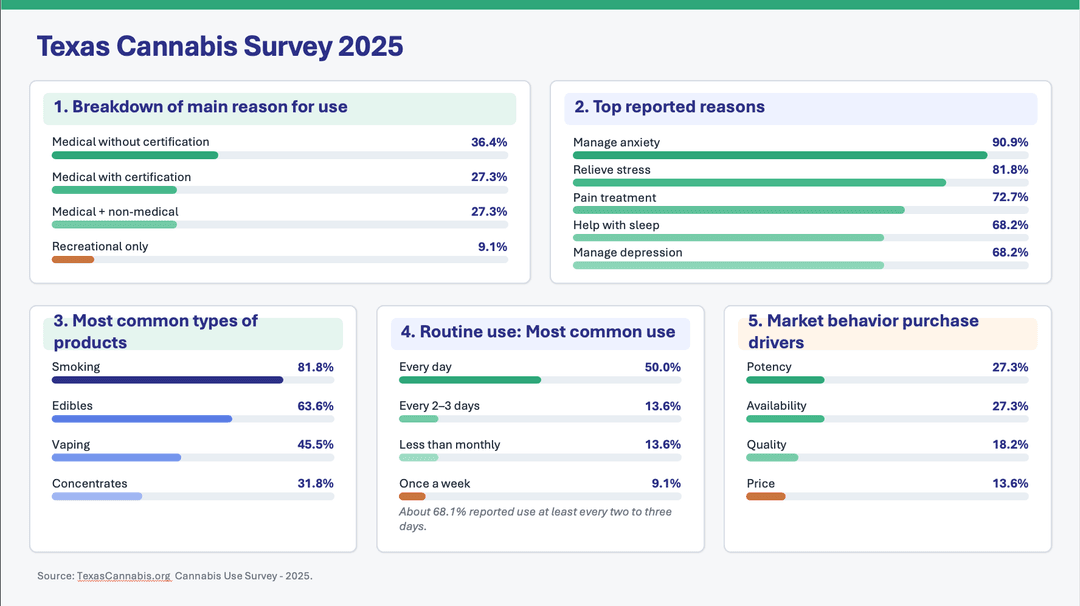
- 36.4% said they used cannabis products medically without certification
- 27.3% said they used it medically with certification through TCUP
- 27.3% said they used it for both medical and non-medical reasons
- 9.1% said their use was purely recreational
The responses point more to relief and symptom management than to casual recreation.
Anxiety, stress, pain, and sleep were the top reasons for cannabis use in Texas
The most common reasons were practical and symptom-driven.
- 90.9% said manage anxiety
- 81.8% said relieve stress
- 72.7% said pain treatment
- 68.2% said help with sleep
- 68.2% said manage depression
These responses show that many Texas consumers see cannabis as part of daily symptom care. They are not talking first about novelty or social use. They are talking about relief.
Texas survey respondents reported frequent cannabis use
The survey points to regular use rather than occasional use.
- 50.0% said they used cannabis products every day
- 13.6% said every two to three days
- 4.5% reported wake-and-bake use
Taken together, about 68.1% said they used cannabis at least every two to three days.
Smoking, edibles, and vaping led Texas cannabis product use
Smoking remained the most common product type, though other forms were also widely used.
Most common product types
- 81.8% smoking
- 63.6% edibles
- 45.5% vaping
- 31.8% concentrates
Most common strain types
- 63.6% indica
- 59.1% hybrid
- 54.5% sativa
CBD content did not appear to guide many Texas cannabis purchases
CBD did not seem to be a major purchase filter for many respondents.
- 68.2% said they did not know the CBD content of the purchased cannabis products
- 13.6% said they knew the CBD content
- 13.6% said their cannabis had no CBD
This may suggest that many respondents focused more on how a product felt than on detailed cannabinoid labels.
Potency and availability were top cannabis purchase drivers in Texas
Texas respondents appeared to care most about strength and access.
Top purchase drivers
- 27.3% potency
- 27.3% availability
- 18.2% quality
- 13.6% price
How respondents bought cannabis
- 72.7% usually bought in-store
- 18.2% used online ordering with delivery
Did respondents research prices first?
- 50.0% said no
- 36.4% said yes
- 13.6% said sometimes
That pattern may suggest product effect and access mattered more than bargain shopping for many respondents.
Some Texas respondents said cannabis replaced other drugs or medications
A smaller share said cannabis had reduced their use of other drugs.
- 18.2% said yes
- 72.7% said no
- 9.1% refused to answer
Responses mentioned cocaine, heroin, methamphetamine, benzodiazepines, opioid pain medicine, and anxiety medication. This does not prove a broad statewide trend. Still, it may suggest that some respondents used cannabis as a harm-reduction option.
Driving after cannabis use remains a concern
One result stood out as a public safety concern.
- 36.4% said they had driven within two hours of using cannabis
- 59.1% said they had not
That figure may suggest that impairment education is still needed, even among users who see cannabis as routine or medically useful.
Texas respondents strongly supported legalization but rated current laws poorly
Support for legalization was high, but satisfaction with current law was low.
Federal legalization support
- 100.0% gave the top score for medical cannabis legalization
- 90.9% gave the top score for recreational cannabis legalization
View of current marijuana laws
- 68.2% gave current laws the lowest possible score for adequacy
That split may be one of the clearest findings in the survey. Respondents appeared strongly supportive of broader legal access, while also seeing the current framework as too limited or out of step with real use.
What the 2026 Texas cannabis survey may suggest
For Texas respondents in this survey, cannabis appeared to serve three main roles:
- a relief tool for anxiety, pain, stress, sleep, and depression
- a routine product used often, not just once in a while
- a policy gap, where consumer behavior may be moving faster than formal access rules